Showing posts with label organic. Show all posts

Saturday, March 14, 2015

First Deliveries!

Well, after weeks of worrying and watering, the first transplants of the season are ready! So, this weekend, I'll be at the farmer's market, and, hopefully, delivering transplants. It's also time to set out my own transplants to begin the 2015 season. All are heirloom, non-GMO, and grown using non-certified organic practices.
2015 Transplants $2.50 each

Early Vegetables: Transplants expected to be ready around March 15 March 21
Broccoli: Waltham 29: Tolerates cold well, but may “button” at colder temperatures.
Broccoli: Early Purple Sprouting: Tolerates cold well, may “button” at colder temperatures.
Broccoli: Calabrese Sprouting: new variety; Likes somewhat warmer temperatures.
Broccoli: Umpquah: Likes somewhat warmer temperatures.
Cabbage: Early Flat Dutch: new variety; reported to be good for kraut!

Small selection, but carefully curated. What do you think of my prices?

What's growing in your Savory garden?

Nancy


Friday, January 9, 2015

Organizing Seeds for My Organic Garden

Sticky notes indicate planting month and ccateory.

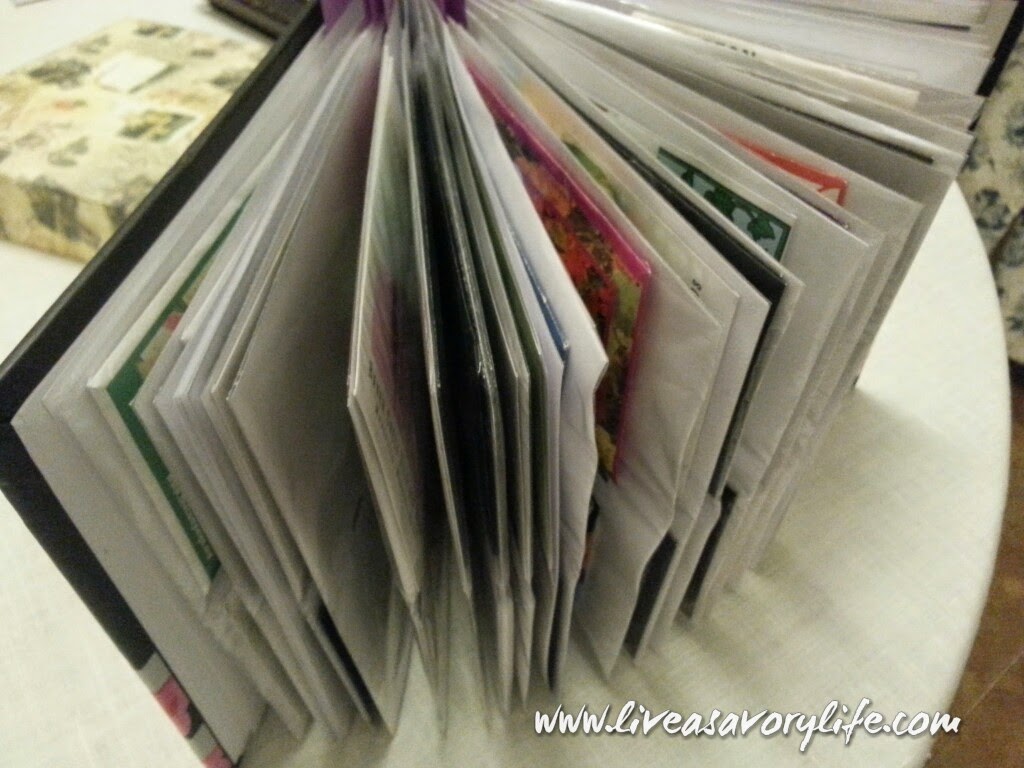
Just wanted to dash off a quick post to explain a little change I've made to my seed albums (remember--I organize my seeds using inexpensive photo albums).

In previous years, I've separated the seeds according to category:  tomatoes, peppers, cucurbits, and so on.  Well, this year, it's occurred to me that it would be more efficient to organize my seeds by planting date, planting method (greenhouse or direct sow), then by category.

Organized in this fashion, I should only have to turn pages rather than searching through each category.  I am hoping this prevents my "losing" seeds like I did last year.

It probably seems ridiculous to start planning this early--the thermometer on my porch registered 3 degrees this morning--but there's really little time once the greenhouse season starts in late January.

I've discovered leftover seed packets for a number of varieties that I still want to try, so many that they will not fit in my raised beds.  So, on to Plan A+:  reopen the 30' x 50' garden plot that lay fallow last year.  This time, I really do plan to use the weed barrier that languished unused last season.

I've already planned my raised beds, so, on another cold winter evening very soon, I'll have to create my plan for the big garden.  Perhaps that will make this year will be more productive.

Full seed packets overfill the album
So, while you're bundled up against the cold, dream of warm spring days as you plan your next garden!

Nancy

Saturday, January 3, 2015

Adding to My Organic Garden Plan

I have a plan.
I love seed catalogs! Colorful, attractive, lush plants that never look like mine but, being the eternal optimist, I keep trying!  So, just after Christmas, as is my custom, I sat down and placed by tomato seed order during TomatoFest's annual sale.  This week, on New Year's Day, I placed my remaining seed order for herbs and vegetables from Baker Creek.  I'm planning to grow more of fewer varieties this year, so it wasn't a very big order.  Carefully, I drew up an intensive plan for my raised beds.  I was feeling really good about the whole process.


I forgot I had ordered these!
Until.

Until I pulled out my seed binder from last year.  (I organize my seed packets in inexpensive photo albums which have space near the binding for notations.)  My binder was bulging, which meant that many of the packets were still full of seeds.

What's even worse is that I had, from last year, unopened seed packets of herbs I'd ordered for this year!  What a violation of my own frugal principles!  I can make excuses that there were many non-farm interruptions last year but those are mostly excuses rather than reasons.  So, I have a decision to make:  do I expand the garden and plant the seeds, or sell them, or give them away?  Common sense says to make one choice, but I think I'll try to do all three, after a fashion.
  1. My big garden plot lay fallow last year even though I have sufficient weed block to cover it.  So, I think I will use the weed block to kill off the existing vegetation, then cultivate there by making double-row beds.  I've always had a soggy spot in the lower part of the garden, so I'm re-orienting the beds/rows to run with the slope instead of against it, although I may put a permaculture-style swale at the higher end of the garden.  Since I have twice as many corn seeds as I expected, I can expand the corn plot!  I also will have room for more squash and beans, which are the bulk of my extra seeds.
  2. I had some success selling transplants last year, so I think I will do the same again this year--especially with the "bonus" seeds.  Many folks in the city just need a few plants rather than a full packet and will pay a premium for organic, non-GMO plants, heirloom plants.  I've found that the organic, non-GMO label is not as attractive in the country, but the heirloom varieties (just like Grandma used to grow) have some attraction, especially when potted for the porch.
  3. Although the Garden Writers Association has the wonderful Plant a Row for the Hungry program, my much smaller version is to give away plants suitable for small beds or containers.  Many folks have limited space, especially retirees, so one or two tomato plants could add fresh nutrients to their diet.  It's kind of my version of "green tithing."

I ordered the exact same herbs this year!
I feel less wasteful for having articulated my plan for these windfall resources.  Now, I really need to sit down and plan my in-ground garden.  I've always let the grass get ahead of me, so I'll be trying intensive planting practices there, too, after a fashion.  I'm still flummoxed as to what to do with the "middles" between the double-rows to prevent the grass incursion.  Any ideas?

I'm also starting the "nursery" earlier, I hope.  If I'm to transplant in March, I need to start broccoli & cabbage by mid-January, which works well since they germinate in cooler temperatures.

I've always started tomatoes around Valentines Day but have found many farmers like to set plants out on Good Friday, which means I need to start early varieties plants two weeks earlier for that market.  Last year, though, a wet, frigid spring meant many gardeners planted tomatoes twice or three times.  My raised beds certainly were a boon in that situation both in drainage and soil temperature.

Peppers will be the last to start as they germinate better in very warm temperatures, and, at least in my area, do better when transplanted later than tomatoes.

As space permits, I'll be starting herbs throughout the season to maintain a fresh supply of potted herbs.  They sold better in pots than flats, so I'll expand that this year.  I'm also considering "recipe" containers:  a tomato plant with basil in the same pot sold as a "bruschetta" pot.  Any ideas other other "recipes"?

I have another reality to face:  it's awfully nice to plan my garden, but, when it's 100 degrees with 90% humidity, it's brutal to work it.  I just won't weed when it's that hot, which is when the garden goes wild.  So, preventative gardening is going to be necessary.  Again, any suggestions?

I still have much to plan, but I feel the greenhouse calling me.  Soon, I'll spend a cold evening recreating that little oasis of growth that is my first glimmer of spring.

Stay warm, and think of your garden!

Nancy


Thursday, December 25, 2014

Organic Garden Planning: Tomato Reviews


The end of last season was especially hectic (when you're a church musician, things really crank up around All Saints Day!), so I'm just now getting around to my annual variety reviews.  I tried an excessive number of varieties last year with mixed results.  I grew a number of varieties, but also sold the plants at a farmer's market.

Two of the three varieties will repeat this year!

A note about farmer's markets:  location matters!  Whereas my city customers were very interested in purchasing organic, non-gmo garden plants, the customers in a small-town in an agricultural area walked right past my organic plants to purchase packs of Early Girls, and Better Boys.  Rather than be offended, I got to know the nurseryman who was quite generous with his knowledge and very friendly.  The hard lesson was:  organic, non-gmo is not a premium product at all markets.  Still, I made wonderful contacts and was able to educate a lot of folks about the value of some of the "old" varieties.


After a year of research, I'm concentrating my efforts on fewer varieties which sold well at the market.  Here are the seedmen's descriptions, followed by my findings with the varieties I'm repeating in '15 marked with an asterisk (*):


Table

I like a mild, sweet tomato with a smoky flavor, and look forward to the first tomato sandwich of the summer.  For variety, though, I grew a number of other varieties last year.

Bradley:  "a wilt-resistant pink-red developed at the University of Arkansas"  
  • okay producer, flavor unremarkable.
*Ozark Pink:  "a tall, flavorful pink suited for humid, disease-prone areas"  

  • survived the great tomato hornworm invasion, produced throughout the season; good flavor
*Arkansas Traveler:  "balanced flavor is the hallmark of this rose-pink suited to heat, humidity, and drought"  

Suckers helped in recovery from hornworm damage!
  • also survived the hornworm onslaught, produced late into the season, good flavor
  • plants sell well because of the Arkansas name connection
Blue Beauty Tomato:  "modest beefsteak whose good flavor and interesting coloration blessed with resistance to sunburn and crack"
  •  pretty but tiny with unremarkable flavor
  • plants sold to experienced growers and gardeners looking for a novelty
*Cherokee Purple:  "prolific rose to purple beefsteak, legendary for its complex flavor"

  • survived the hornworm invasion, good producer, excellent flavor
  • plants sold out at market; name recognition helps
*Black Trifele:  "the shape and size of a Bartlett pear with a beautiful purplish-brick color"

  • flavor-wise, probably my favorite because of its mild and smoky flavor; much smaller than a pear for me, with a few cracks.  Not a prolific producer, but worth the trouble.
  • plants sold well at market, expecially because of "smoky" flavor
*Black Krim:  "3-4" slightly flattened dark-red (mahogany-colored) slightly maroon, beefsteak tomatoes with deep green shoulders"
  • Name recognition makes this a good market-seller for plants
  • Good flavor


Canning/Paste
While taste is important, essential criteria are a high meat/juice ratio, low seed count, and productivity.  I think for 2015, I'll put up salsa and spaghetti sauce for maximum convenience.

Costoluto Genovese:  an Italian red, almost ruffled, described as a pungent sauce tomato;

  • excellent producer, but unremarkable flavor, would grow as a specialty tomato:  its ruffled slices look very pretty on sandwiches presented open-faced.
  • Plants were not a great market seller without a picture
Debarao:  an early red paste variety, small but crack-free:  

  • unremarkable flavor
  • Plants were not a good market seller
*Early Annie:  short plant with few seeds, fruit matures all at once:  

  • good flavor, actually produced all season for me.
  • Plants sold well at market because, I suspect, people may have confused them with the "Early Girl" varieties
Tennessee Sweet:  suitable for slicing or canning, a large red sweet:  

  • good flavor, but not a great producer.
  • Plants were a decent market seller because of the Tennessee name connection
Big Italian Plum:  a large red thick paste plum:  

  • did not produce well for me for the second year
  • Plants did not sell well at market
*San Marzano Gigante:  the legendary flavor and twice the size!:  

  • good flavor, and excellent producer:  prolific nearly until frost
  • Plants sold well at market; many recognized the name
  • I'm actually planting San Marzano Redorta this year, but looking forward to a good harvest


Currant

The flavor of these single-bite beauties just explodes on the palate!  They are more bushes than vines and enjoy cages.  Be sure to space them so that you can pick from all angles.  I  gave a farmer friend several of these plants back in the spring.  Later in the summer, he told me that his father--a farmer, too--picked the bush clean every time he came over!  Great for beginners! 

Broad Ripple Yellow Currant:  big bush, sweet, prolific:  

  • always a good choice, unusual color
*Hawaiian Currant:  tiny, sweet, tasty:  

  • smaller than you think, but tasty!
  • Good market seller

White Currant:  heavy clusters, very sweet: 

  •  did not plant
Red Currant:  smoky, sweet, tiny, prolific:  

  • great taste, great snacking tomato
*Gold Rush Currant:  "large, indeterminate, regular-leaf tomato plants with wispy foliage that yield excellent, heavy sets of 1/4-inch tomatoes borne in trusses of 10-12"
Goal for 2015:  Even more tomatoes!
  • Heavy producer, great flavor
  • Good market seller
New for '15

Even though I'm cutting back on varieties, I am making room for a few new ones:

Arkansas Marvel:  "4-inch, 1 lb., meaty, yellow-orange beefsteak tomatoes with red marbling with a gush of wonderful sweet, well-balanced tomato flavors that hold a distinct hint of mild, peach flavors"

Homestead 24:  " smooth, red, round 8 oz. fruits with exceptionally good taste"

As my gardening skills improve, I have to become even more diligent about watching the "bottom line" and increasing margins.  After all, I hope not only to feed my family, but to make the farm self-supporting.  That will require planning; it's not too early to start!

What's growing in your Savory garden?

Nancy

Sunday, August 19, 2012

Garden's Bounty


Black Truffle tomatoes,
fresh off the vine!
The tomatoes are finally in, after a fashion, and last night's supper was a yummy Black Truffle tomato and Vidalia onion vinaigrette sandwich.  My tomato experiment has met with moderate success this year.  The only tomatoes which have set fruit reliably have been the Golden Currant tomatoes and the Black Truffles.

The Golden Currant tomatoes have become my go-to snack.  They're kind of like vegetable "Gushers" because they are so juicy and the flavor just explodes into your mouth.

For some reason, the Red Currant tomatoes have not set fruit well.  None of the other varieties has been as reliable as the Black Truffles.  I think I'll give them another few weeks before I pull up the non-producers.

The pepperoncini and serrano peppers have been quite prolific.  The Chinese giant and Tennessee cheese peppers have been small, although nicely flavored.  The poblanos have been smallish but yummy, and the jalapenos are just now producing.  The cayennes are tiny but numerous, and the tobascos are nearly ripe.  We're finishing summer on a "hot" note.


Carrot seedlings
While the summer garden is winding down, I've started my winter container "garden" which will live on the porch.  One pot contains Scarlet Nantes carrots which should be ready to harvest just around the time of our first frost date in mid- to late-October.


Tiny dinosaur kale!
Another pot contains an Italian heirloom kale variety called 'Lacinato.'  Sometimes called 'dinosaur' kale because of its curly leaves, it should stand the cool autumn nights to come.  I cannot wait to add it to Italian wedding soup on a cold winter's evening!

Small Sugar pumpkins
A third pot has been outfitted with a wire column for pumpkins (var. 'Small Sugar').  These are not for jack-o-lanterns; they're pie pumpkins.  With a growing season of 90 days, they'll have to be sheltered if I want freshly made pumpkin pie for Thanksgiving.

I have plans for a fourth pot for spinach.

Watering the newly transplanted
oaks from the water
barrel on the back of the truck.
Since the weather has been so cool this weekend, we also transplanted several oak trees (red oaks and willow oaks) salvaged from my husband's parents' flowerbeds and fencerows into our front yard.  We built our house on a former hay field and have spent the years since planting trees to shade us from the afternoon sun:  buckeye, maple, pear, willow, tulip poplar, and several native varieties of oak.  The tallest is six feet tall, but, in a few years, we'll begin to feel the effect of our efforts.

The time the Resident Dragon and I spent outside yesterday has given us the opportunity to discuss some major changes in the garden layout for next season.

They're still really iffy, but I'll share them when we've firmed them up!

So, what's coming up in your garden?

Nancy

Sunday, March 18, 2012

Seeds of Challenge

Mary Washington Asparagus under the lights.
One of the things I love about starting plants from seed is that there are so many surprises.  I don't know what I expected from the asparagus, but it's shocked me:  it's nearly two inches tall!  It's appearance is even more fun--it looks like tiny asparagus spears!