Showing posts with label peppers. Show all posts

Thursday, March 13, 2014

Spring Chores Fill Warm Late-Winter Days

One of my favorite
places to be!
It's been a really busy week here on the farm!  After, seemingly an eternity of frigidity, Tuesday was a lovely warm spring day.  As a bonus, it has not rained in a week or so leaving it dry enough for one of my favorite activities:  bushhogging!  Our fallow fields are covered in sedgegrass, which needs to be cut at least twice a year, giving me a great excuse reason to get on the tractor.  I had not counted on the reproductive cycle of sedgegrass, though, and kicked up a cloud of seed floaters.  Before I quit for the day, the tractor was wheezing as much as I was!

I had to stop at least 10 times
to clean the radiator screen!
Wednesday, on the other hand, was cold with a biting north wind.  Great for blowing the sedgegrass seeds, but really, really bad for fertilizing the blueberries (Espoma's organic Holly-Tone 4-3-4), blackberries (organic Garden-Tone 3-4-4 after pruning!), and fruit trees (Garden-Tone)  I could only bear it for a few hours of bushhogging and yardwork before seeking warmth in the house.

Poor germination in onions
from 3-year-old seed
Today was a bit warmer so I finished fertilizing the shade trees and shrubs (Garden-Tone), and enjoyed time in the sun while stabilizing a wobbly mailbox.  (Tractors and power tools:  what's not to love about the farm!)  The greenhouse trays were dry so my seven new rose bushes will just have to wait on the porch another day or two!

First to sprout and growing quickly!
The greenhouse is in full swing, although the peppers and a number of the tomatoes are being a little stubborn about germinating despite the warmth, light, and high humidity the greenhouse affords them.  Early Annie and Debarao, as well as San Marzano, varieties are in the "lead" of the race to readiness to plant with Cherokee Purple and Arkansas Traveler close behind.

The chores aren't done, though.  The roses need to be fed (Rose-Tone 4-3-2).  Broccoli should be ready to plant in the raised beds on Saturday, and cabbage early next week. Should I put carrots in between the broccoli and cabbage? Wow!  I think I'd better get that livestock panel to make a "greenhouse" for one of the raised beds.

Hardy currant varieties can be
a little fussy about germination.
 It's been a great week, and I've enjoyed the spring startup chores.  I can't wait to see what this year's yields are.  I hope you are enjoying occasional breaks in the winter weather!

What's growing in your Savory garden?

Nancy


Saturday, August 24, 2013

Lessons from My Organic Garden 2013 Edition

Muscadines
Well, I'm not putting a current picture of the garden in this post because, well, the crop I grew best this summer was grass.  Yup.  Grass.  All in the garden.  I was ill for about 2 weeks early in the summer and it just took over.  Yes, I've tried some to keep ahead of it, but it's stronger than I am.  In the next week or two, I'll be fishing the soaker hoses out of the grass and tilling it all under.  All is not failure, however, although the vegetables just could not compete with the grass for nourishment.  So, lessons learned from this year, so far:

Cucumber!

Weeding

  • I hate weeding.  I don't weed.  I don't care how cool it is; I do not weed.  This is a major problem for an organic gardener.
  • If I will not weed, I must either mulch or plant in rows.
  • No-till isn't working for me; the aforementioned grass takes over the mulch crop.
  • Intercropping is not working either.  The grass takes over before the "inter" crop establishes itself.
Sprouting bulblet of a "walking" onion.

Gardening method

  • "Strip" gardening (tilled strips 3' x 25') has too much opportunity for grass incursion.  It's just not working.
  • Raised beds have worked well for the ginger and turmeric.  Consider planting more, but do make them 3' wide rather than 4'.
  • "Market garden" crops should be grown either in rows, cultivated with a tiller, or under plastic mulch/gardener's cloth covering soaker hoses.
Ginger and turmeric

Crop Selection

  • Even heat-tolerant varieties of broccoli and cabbage can't tolerate the unrelenting direct sun of my garden.  Plant them earlier or later.
  • San Marzano, Rutgers, and Oxheart tomatoes have done well.  Plant them again.  Currant tomatoes should be planted in single rows with harvest space all around.
  • Although White Wonder, Sumter, and Edmonson cucumber varieties have produced well, I need to find a smaller variety for pickling.
  • Go with the same pepper selection next year, but be sure to mulch with plastic as well as feed more heavily:  jalapeno, Tennessee cheese, serrano, King Arthur, among others.
  • Annual "garden" crops are too labor-intensive; increase blackberries and find additional perennial crops.

A luscious fig!

The Future

  • Blackberries!  They like my dirt and their cultivation schedule works with mine.
  • Turmeric?  What's above ground looks good, but we'll see how the rest turns out.  It is planted in a raised bed with . . .
  • Ginger?  It's really scruffy looking, but new leaves mean new "fingers" on the hand-shaped ginger root.
  • Figs:  The fig trees are producing more this year, and enjoying the heat.
  • Catawissa/Egyptian/Walking Onions:  They grow well in a pot, and every part of the plant is edible.  The bulb is like a small shallot and tastes like a spicy scallion.
  • Other specialty crops:  Do you have any suggestions for specialty crops?
So, I'm shutting the garden down early this year.  I've already started the container garden on the porch and am considering a low tunnel outside.  There is so much to learn, but . . .

The greatest lesson about gardening is that there is always next year.

A Thank You!


I'd like to share a little "next year" with you.  I'll send 10 "walking onion" bulblets to five of you who take the time to offer suggestions for next year's specialty crops in the next two weeks.

What about you?  What's growing in your Savory garden?

Nancy

Monday, May 6, 2013

Organic Gardening: Mucking Around


Deer tracks across my garden strip!
April was an insanely busy month, and May is shaping up to be more of the same.  Nonetheless, we managed, here on April 30, to set out our first transplants.  We set out about 8 Gold Rush currant tomatoes, and about 10 Rutgers original strain.  We had planned on more, but other tasks delayed us.

Being the lazy gardener that I am, I asked the Resident Dragon to "drill" the holes with his trusty bulb auger, which made quick work of the digging task.  We worked until it was so dark we could not see.

It's now five days, a light frost, and two inches of rain later.  I put out some of the tomatoes (more Rutgers, Bloody Butcher) and peppers (early jalapeno) yesterday, but every time I drilled a hole, it filled with water.  After about an hour I had only planted about one-third of the plants, and had sunk to mid-calf in the fine-grained buckshot mud.  So, I decided to finish on a slightly drier day, and came inside to inventory the remaining plants.

The variegated weigela
is beautiful!
My next planting day will be a busy one and will involve fertilizer and bone meal!  I also need to devise the tomato trellis and set up the cucumber fence.  While I feel like I'm behind, I'm actually about two weeks ahead of last year when I did not set out my first plants until the first week in June due to a cold snap in early May and heavy late-spring rain.  Here's hoping I can get a jump on the summer.

The heavy rains have been wonderful for the rest of the garden:  many of the blackberries are blooming, the blue berries are fruiting, and the fruit trees and muscadines are leafing out nicely.

Abraham Darby is
the first rose of the year in my garden!
The roses I trimmed so severely in February are just beginning to bloom.  I feared I had been too ruthless in the pruning, but, it appears, that was just what they needed.

There is so much yet to do, as always.  I hope for some weather dry enough for the ground to be workable so I can plant seeds directly into the ground.

So, despite the rain, and the late cold despite a very mild winter, I am optimistic about this season.  I have to be.  The past two years have seen disruption in my garden plans.  Two years ago I developed a severe infection from a tick bite and was sick most of the summer.  Last year, my father-in-law was ill and I took care of both his garden and mine--poorly.  This year, I'm sure, will bring other challenges, but I'm ready.

I think.

If not, there's always next year.

What about you?  What's growing in your Savory garden?

Nancy

Thursday, January 10, 2013

Pepper Varieties for My Southern Organic Garden


One day's bounty!
The Resident Dragon loves hot and spicy food, and last year's garden supplied him with many special treats.  While tomatoes have been a constant source of frustration for me, peppers have produced well in my poor soil.

Installing soaker hoses under grass-clipping mulch conserved water and helped the peppers continue producing despite an extremely dry summer.


Varieties which have worked well for me are:


Anaheim:  Medium-hot, good for drying

Jalapeno M:  Classic hot pepper, hotter than usual

Marconi Rosso:  A large, sweet pepper suitable for stuffing, grilling, or frying

Chinese Giant Sweet:  A large bell-type pepper

Tennessee Cheese:  A Tennessee cultivar of a Spanish sweet pepper.  Tomato-shaped, thick-fleshed, and suitable for stuffing, pickling, canning, or drying.

Serrano Tampiqueno:  Prolific, about 2" long, very hot

The habaneros produced
until the frost killed them!
Habanero, Orange:  Very hot, very prolific, loves hot weather

Cubanelle:  A large, sweet pepper, excellent for frying

Jimmy Nardello:  Long, thin, sweet frying pepper

Pepperoncini, Greek:  Mildly hot, extremely prolific, excellent for pickling

Tabasco:  Very small, very hot, all ripen at one time which is great for making hot sauce

Pepperoncini, Italian:  Longer and thinner than Greek, but mild and extremely prolific
Pickled pepperoncini

Cayenne Blend:  Hote, edible ornamental with yellow, green, red, and purple fruit

Since I have had such good success with peppers, I'm expanding the varieties next year.  Here's what I'm trying:


Melrose Frying:  Small, sweet, early, and suitable for frying, salads, and roasting

Bull Nose (Large Sweet Spanish):  An old sweet bell variety, suitable for stuffing and pickling

World Beater (Ruby Giant):  Heirloom sweet bell, reputed to be prolific

King Arthur Hybrid (formerly Fat n' Sassy):  Sweet bell, large and early

Peppers love hot weather!
Jalapeno Early:  Very hot jalapeno, earlier and suited to cooler weather

Serrano Chili:  Hot, prolific, easy to use

Cayenne Purple:  Hot, suitable fresh, pickled, or dried

Cayenne, Long Thin:  Long, slender, very hot

Because pepper seeds require high soil temperatures to germinate (80 degrees), I think I will be investing in seedling mats this year in addition to keeping my little "greenhouse" very warm.

Watch in the next few weeks for details about my new "greenhouse."  I can't wait to get started.

So, what's growing in your Savory garden?

Nancy

Monday, October 1, 2012

Bedtime for the Vegetable Beds

Last hurrah . . .
I had planned to turn under the entire garden today, but this is what I found:  tomatoes--more tomatoes than I've seen in a while.  I found so many tomatoes that I could not bear to till them under, so this little patch of currant tomatoes (and one lone Black Truffle plant) have been spared another week.  The tobasco peppers should be ready this week then that bed will be put to bed.
Final harvest . . .

Sunday, August 19, 2012

Garden's Bounty


Black Truffle tomatoes,
fresh off the vine!
The tomatoes are finally in, after a fashion, and last night's supper was a yummy Black Truffle tomato and Vidalia onion vinaigrette sandwich.  My tomato experiment has met with moderate success this year.  The only tomatoes which have set fruit reliably have been the Golden Currant tomatoes and the Black Truffles.

The Golden Currant tomatoes have become my go-to snack.  They're kind of like vegetable "Gushers" because they are so juicy and the flavor just explodes into your mouth.

For some reason, the Red Currant tomatoes have not set fruit well.  None of the other varieties has been as reliable as the Black Truffles.  I think I'll give them another few weeks before I pull up the non-producers.

The pepperoncini and serrano peppers have been quite prolific.  The Chinese giant and Tennessee cheese peppers have been small, although nicely flavored.  The poblanos have been smallish but yummy, and the jalapenos are just now producing.  The cayennes are tiny but numerous, and the tobascos are nearly ripe.  We're finishing summer on a "hot" note.


Carrot seedlings
While the summer garden is winding down, I've started my winter container "garden" which will live on the porch.  One pot contains Scarlet Nantes carrots which should be ready to harvest just around the time of our first frost date in mid- to late-October.


Tiny dinosaur kale!
Another pot contains an Italian heirloom kale variety called 'Lacinato.'  Sometimes called 'dinosaur' kale because of its curly leaves, it should stand the cool autumn nights to come.  I cannot wait to add it to Italian wedding soup on a cold winter's evening!

Small Sugar pumpkins
A third pot has been outfitted with a wire column for pumpkins (var. 'Small Sugar').  These are not for jack-o-lanterns; they're pie pumpkins.  With a growing season of 90 days, they'll have to be sheltered if I want freshly made pumpkin pie for Thanksgiving.

I have plans for a fourth pot for spinach.

Watering the newly transplanted
oaks from the water
barrel on the back of the truck.
Since the weather has been so cool this weekend, we also transplanted several oak trees (red oaks and willow oaks) salvaged from my husband's parents' flowerbeds and fencerows into our front yard.  We built our house on a former hay field and have spent the years since planting trees to shade us from the afternoon sun:  buckeye, maple, pear, willow, tulip poplar, and several native varieties of oak.  The tallest is six feet tall, but, in a few years, we'll begin to feel the effect of our efforts.

The time the Resident Dragon and I spent outside yesterday has given us the opportunity to discuss some major changes in the garden layout for next season.

They're still really iffy, but I'll share them when we've firmed them up!

So, what's coming up in your garden?

Nancy

Tuesday, July 24, 2012

The Garden's Heating Up!

Why do I always let the garden get out of hand?  The RD has been kind enough
to use the gas trimmer on the grass in the tomato strip.
Although they looked to be the feeblest plants at first, the
Greek and Italian pepperoncini is producing
prolifically!
Tiny fruit on the brown turkey fig tree!
The heat is shimmering and the grass is growing so quickly you can almost see it spreading through the garden.

The gardening is most effectively done in the morning and the evening so I was out early while the grass was sopping wet with the heavy dew.

The Resident Dragon has been kind enough to "weedeat" my garden after I let the grass get out of hand despite the heavy mulching.  I've gathered more mulch and will soon add it on top of the existing for both fertilization and weed control.

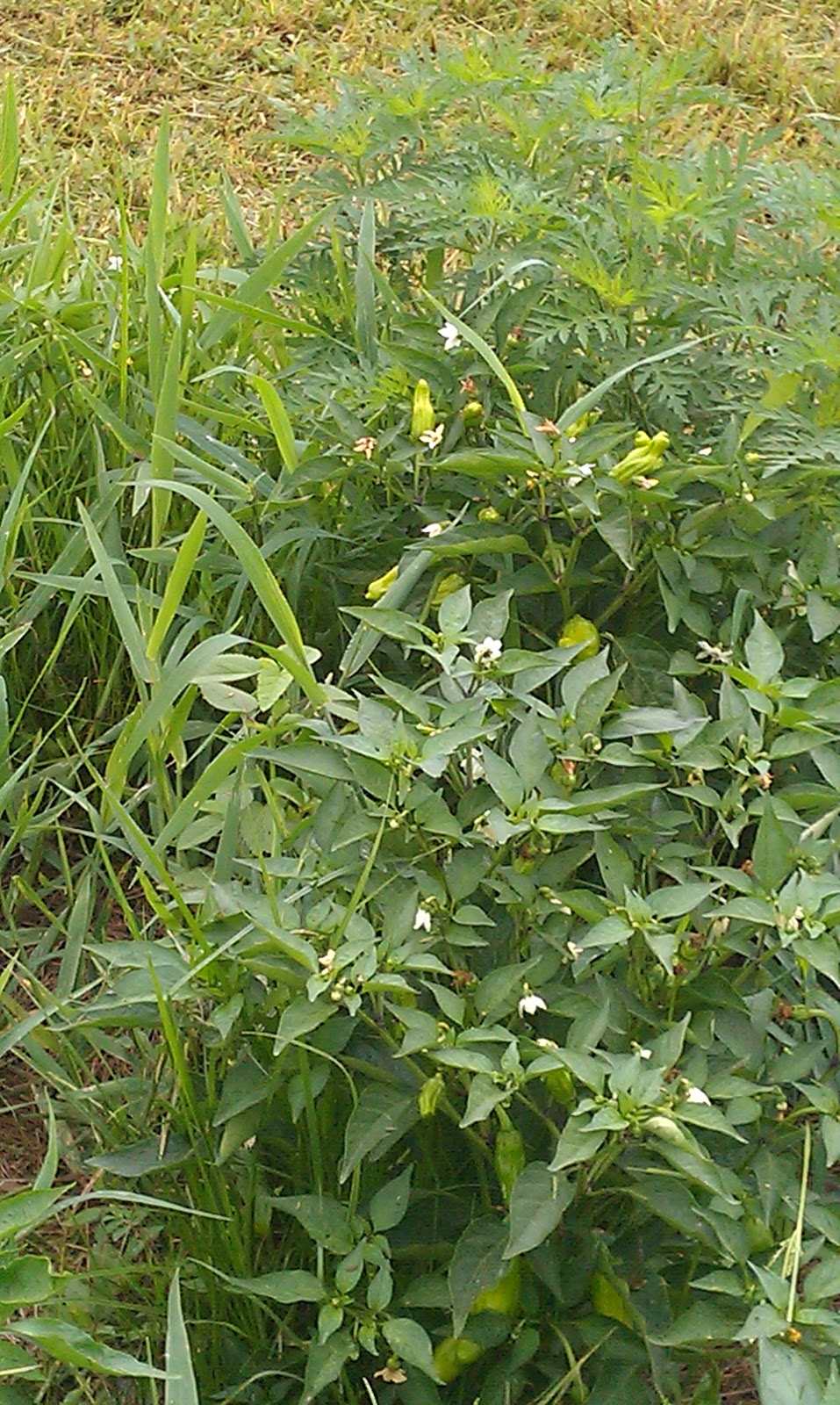
More peppers among the grass!
Because they were set out in late May, the tomatoes are just now beginning to come in.  The currant tomatoes have been producing for a while, but are setting fruit nicely.  The other varieties should begin coming in late this week, with the Black Truffles leading the way.  The Florida Pinks have not set fruit well, but the Creoles and the Italian Tree tomatoes have a few large and many small tomatoes.

After I fertilized all the plants--bone meal for the tomatoes, and a balanced fertilizer for the rest--I noticed a beautiful luna moth on my daughter's window screen.  I could not resist taking the picture, never realizing I was in it, too!

This okra has "volunteered"
in the compost pile.
A beautiful luna moth on my
daughter's window screen.
My reflection is behind it.
I had almost despaired of having any figs on my tiny trees this year but, surprise!, there are several of them.  Now if the deer (who have discovered the tomatoes) will ignore the figs, I might be able to prepare one elegant dessert from the crop.

The muscadines also surprised me with three tiny fruits on one of the vines.  Hopefully, this is the beginning of many fruitful years.

A trip to the compost revealed that the "volunteer" tomato plant was thriving, although not fruiting yet.  The volunteers I had thought to be squash turned out to be okra!  The okra loves the heat and will produce well with minimal amounts of water.

Once the heat of the day set in, I set about pickling the pepperoncini I had planted especially for the RD.  Already, the plants have produced four pints!

The continuing grass problem has me thinking about next year already.  Do I want to try something new, like raised beds and purchased soil?  I don't know.  Until them, I have plenty to keep me busy.

How are thing in your garden?

Nancy


The first of the pepperoncini crop:  four pints!


Thursday, October 27, 2011

This Garden Is Hot!


Habanero Peppers


The garden is really making progress despite the heat and because of a few extra waterings in between the scant rain.  Especially prolific are the peppers and, of course, the grass, purslane, and other wild plants.  I've let the wild plants get ahead of me and have resorted to mulching the peppers with yard clippings.  We do not use any herbicides on the lawn, so the clippings should be safe to use and should even improve the nitrogen content of the soil.

The jalapeno plants have been a bit delicate, but the others, including California Wonders, are thriving.  I also have peppers in containers which are doing well, too.  It's not too late to start your own container peppers.  Give it a try!


Cubanelle Peppers


Cayenne Peppers

Thank You Very Mulch!

 Every year I begin my garden with the best of intentions to control pests and weeds.  As long as it's cool, I manage fairly well.  Sometime during the summer, something usually happens to interrupt my efforts:  a rainy spell, an unexpected opportunity that takes me away for a week or so, or an illness.  This year, all three intervened and the grass took over (left).  No matter how much I worked, the grass and weeds grew faster than I pulled.  It became obvious I needed to work smarter rather than harder.

Last year, I had tried using black gardener's cloth to prevent grass and weeds.  It did, but it also impeded water reaching plants.  I knew I would not be satisfied with that solution.  Then I picked up the most recent issue of Mother Earth News which contained an article about mulches.  Eureka!

Now, I've been feeling guilty about not composting the untreated (NO herbicides!) grass clippings from my nearly 2 acre yard.  After all, the soil in my garden turns rock-hard during the dry summer and could certainly use organic amendments.  So, I pulled out the lawn sweeper, attached it to the mower, and enjoyed a lovely summer evening riding around my freshly-mown front yard.

What was not as fun was pulling as many of the weeds as I could bear on the next cool morning.  But pull I did, and spread the now-brown grass clippings in a 2 inch layer around my pepper plants leaving some room around the stems.  I stood aside and waited.  And waited.  And watered--it's been a rather dry summer.  And waited.  And smiled.  After two weeks, the grass had grown around the edges and was leaning in, but had only just begun to peep through the mulch.

I clipped the edges and piled on another layer of mulch.  An added benefit was the nutrients the decaying grass supplied to my struggling plants.  So, I'm now a believer in the power of mulch.  I'm already plotting my mulch strategy for next year!